

 Cart is empty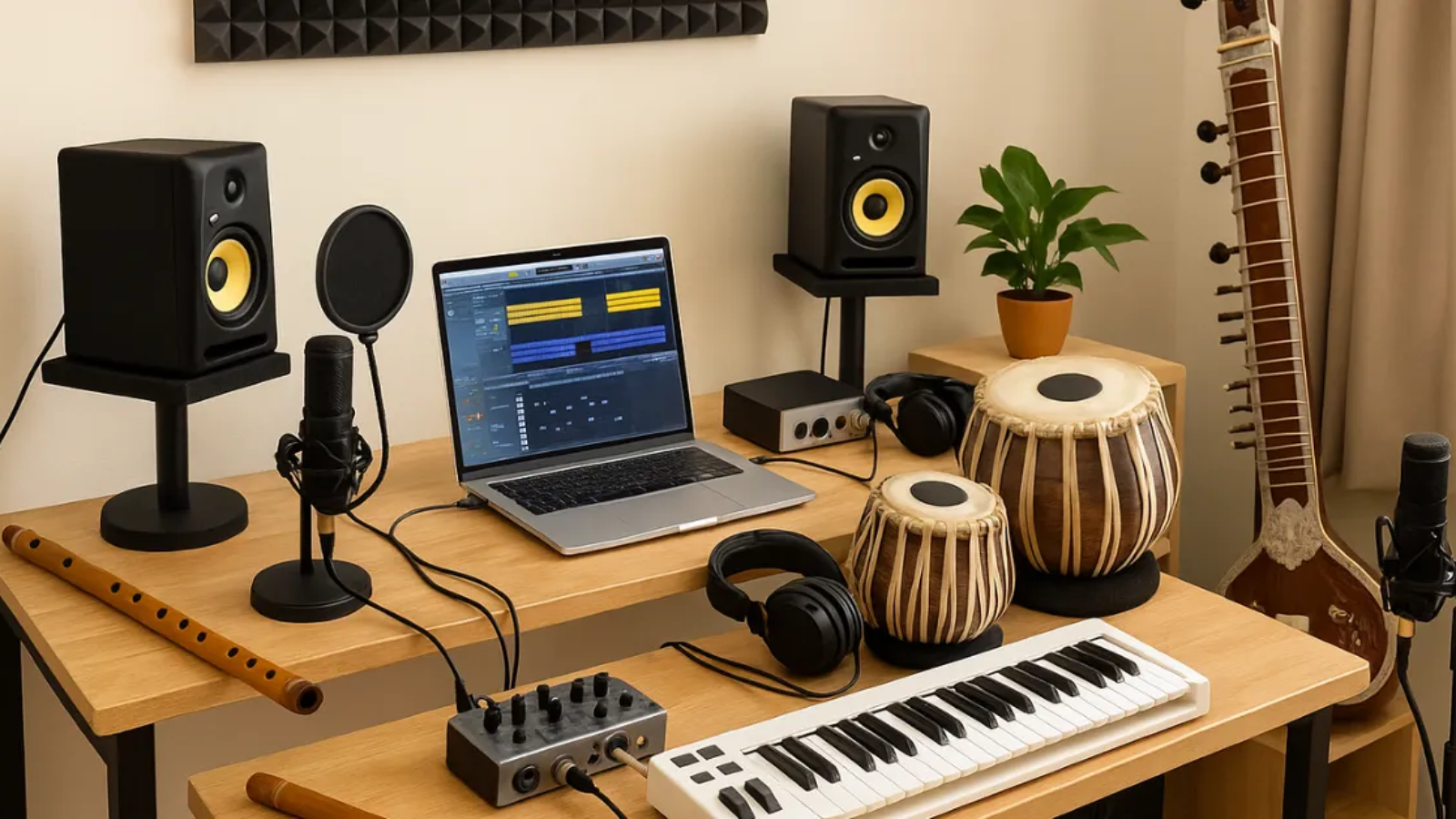
Learn how to set up your home recording studio with essential gear, setup tips, and Indian instruments to record professional music at home.
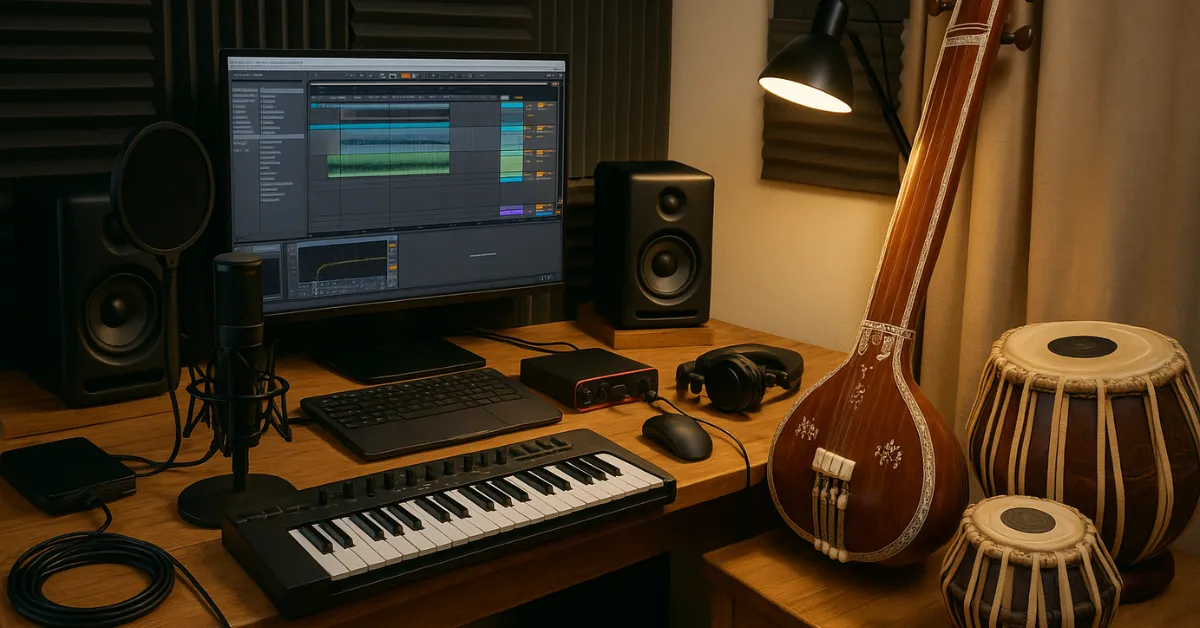
In today’s digital era, the ability to set up your home recording studio opens the door to unlimited creative potential. Whether you’re a classical vocalist, a tabla artist, or an electronic music enthusiast incorporating Indian instruments, a well-designed home studio can help you record, edit, and produce music with professional quality. And the best part? You don’t need a massive space or a huge budget to get started. With the right gear and smart setup strategies, even a corner of your room can be transformed into a music production haven. In this detailed guide, we’ll walk you through every step—from choosing the right gear to optimizing your space—for musicians who want to create magic right from their homes.
1. Choose the Right Space for Your Studio
Your first task is finding a quiet and acoustically balanced space.
- Prefer smaller rooms with minimal echo.
- Avoid rooms with tiled or empty walls.
- Use rugs, bookshelves, and curtains to absorb sound.
- Ensure there’s access to power outlets and ventilation.
2. Invest in a Good Quality Microphone
Your microphone captures every detail, so choose wisely.
- For Indian vocals, condenser microphones are best for clarity.
- For tabla, mridangam, or dholak, use dynamic microphones for handling strong beats.
- Popular choices: Audio-Technica AT2020, Shure SM58, Rode NT1-A.
3. Select an Audio Interface
An audio interface connects your microphone/instruments to your computer.
- Choose interfaces with phantom power (for condenser mics).
- Look for low-latency drivers and at least 2 inputs.
- Top picks: Focusrite Scarlett 2i2, Behringer UMC22, M-Audio AIR 192.
4. Use a Reliable Digital Audio Workstation (DAW)
A DAW is your virtual studio where recording and editing happen.
- Free DAWs like Cakewalk or Tracktion T7 are great for beginners.
- For Indian classical mixing, Cubase or Ableton Live offer advanced options.
- Ensure your DAW supports VST plugins and MIDI compatibility.
5. Get Studio Monitor Speakers or Headphones
Good sound output is crucial for mixing.
- Use flat-response studio monitors for accurate playback.
- Budget options: Mackie CR3, PreSonus Eris 3.5.
- Alternatively, use closed-back headphones like Audio-Technica ATH-M40x.
6. Acoustic Treatment is a Game-Changer
Soundproofing ensures that outside noise doesn’t spoil your recording.
- Use foam panels on walls.
- Bass traps in room corners help reduce low-frequency buildup.
- Thick curtains or mattresses can be used as DIY solutions.
7. Include Indian Instruments in Your Setup
Make your studio fit for Indian music.
- Use clip-on mics for flutes, veena, or sitar.
- Use a room mic plus close mic setup for tabla, mridangam, and ghatam.
- Keep a tanpura app or electronic tanpura ready for reference tones.
8. Add a MIDI Keyboard for Composition
A MIDI controller helps create background scores and fusion compositions.
- Choose a 49-key MIDI keyboard with velocity sensitivity.
- Plug it into your DAW to trigger virtual instruments like Indian tabla loops, sitar VSTs, or sarangi plugins.
9. Keep a Microphone Stand and Pop Filter Ready
Don’t hold the mic in your hand—it reduces quality.
- Use a stable mic stand to position your microphone at mouth or instrument level.
- Use a pop filter to reduce harsh “p” and “s” sounds, especially in vocals.
10. Use External Storage for Project Backups
Music projects can consume a lot of space.
- Use a dedicated external SSD for speed and reliability.
- Save sessions in multiple formats and keep backup copies.
11. Power Backup is a Must in India
Avoid losing work due to power cuts.
- Use a UPS (Uninterruptible Power Supply) for your PC and audio interface.
- Save your session every 10 minutes manually or set autosave.
12. Consider a Laptop or Desktop with Good Specs
Your computer is the heart of your studio.
- Aim for at least 8 GB RAM, i5 processor, and 256 GB SSD.
- If you use sample-heavy VSTs, 16 GB RAM is recommended.
13. Learn Basic Mixing and Mastering
Recording is only half the journey—mixing and mastering polish your track.
- Learn how to use EQ, compression, reverb, and panning.
- Use Indian reference songs to compare levels.
- Explore YouTube tutorials or platforms like Coursera for mixing lessons.
14. Use Mobile Recording Apps for On-the-Go Music
If you’re traveling or short on space:
- Try apps like BandLab, GarageBand, or n-Track Studio.
- Plug in a Lavalier mic or a USB mic with an OTG cable.
15. Keep Your Cables and Gear Organized
Messy cables = bad vibes and interruptions.
- Use cable ties, labelled organizers, and a small drawer unit for gear.
- Keep spare XLR cables, jack converters, and USB cables handy.
16. Create a Comfortable and Inspiring Atmosphere
A peaceful setup enhances creativity.
- Add a small lamp, plants, or artwork related to Indian music.
- Keep instruments like bansuri, tabla, or tampura in the room to spark ideas.
17. Learn How to Record Indian Vocals Perfectly
Indian vocals need special attention.
- Record in dry conditions (no reverb), then add effects later.
- Use reverb plugins suited for Indian bhajans or classical renderings.
- Layer multiple takes to add richness.
18. Record Indian Percussion the Right Way
Instruments like tabla, mridangam, and dholak need careful miking.
- Use two mics: one for the bass head and one for treble head.
- Keep a balanced mic distance to avoid distortion.
- Record in a room with low reflections.
19. Connect Instruments Through Direct Input (DI)
Some instruments can be plugged directly.
- Use a DI box for electric guitar or keyboard.
- For harmoniums with pickups, connect directly to the interface.
- Check for ground loop issues when connecting AC-powered instruments.
20. Keep Practicing and Updating Your Setup
No studio is ever perfect—it evolves with you.
- As your skills grow, upgrade mics, monitors, or add soundproofing.
- Join music production forums, follow Indian YouTubers like T-Series StageWorks, 99Sounds India, or Nirvana Digital.
- Keep creating and sharing to improve.
Conclusion
Setting up your home recording studio may seem intimidating at first, but with the right gear, planning, and a bit of Indian musical flavor, it becomes a fulfilling journey. From capturing the deep tones of a mridangam to layering the haunting notes of a bansuri, your home studio can handle it all with the right setup. Whether you’re a beginner or a semi-pro musician, learning how to set up your home recording studio empowers you to create, record, and publish music at your own pace. With smart investment and consistent practice, your humble home corner can turn into a space where soulful Indian melodies come to life.
At NMS Musicals, we offer a comprehensive range of musical instruments, including percussion, string, wind, and keyboard instruments. Our services encompass sales, expert servicing, and the manufacture of leather instruments. Explore our diverse collection and find the perfect instrument to suit your musical needs.
Visit our website to browse our offerings: nmsmusicals.in
For a closer look at our products, check out our shop page: nmsmusicals.in/shop
Stay connected with us through our social media channels:
- Facebook: https://www.facebook.com/nmsmusicalinstruments/
- Instagram: https://www.instagram.com/nmsmusicals/?hl=en
- YouTube: youtube.com/@nmsmusicals
Our shop locations are:
- Puducherry: 149, Perumal Koil Street, Heritage Town, Puducherry, 605001.
Map Link: https://maps.app.goo.gl/ejDwBBFEJmd3szxk7 - Chennai: No: 1, 1st Floor, Kandigai Street, TVS Nagar, Korattur, Chennai – 600076.
Map Link: https://maps.app.goo.gl/7oXmB6X7KQsqeuuw9
For inquiries, contact/Whatsapp us at 9500663895 or email us at laxman.m89@gmail.com.
Discover the world of musical instruments with NMS Musicals today!
For a visual overview of our percussion instruments, watch the following video:
Leave A Comment
You must be logged in to post a comment